The Five Design Decisions That Make a News Game Work — and the Three That Sink It

The Five Design Decisions That Make a News Game Work — and the Three That Sink It

There is a difference between a sundicated game, and one built especially for a local publisher

The Five Design Decisions That Make a News Game Work — and the Three That Sink It

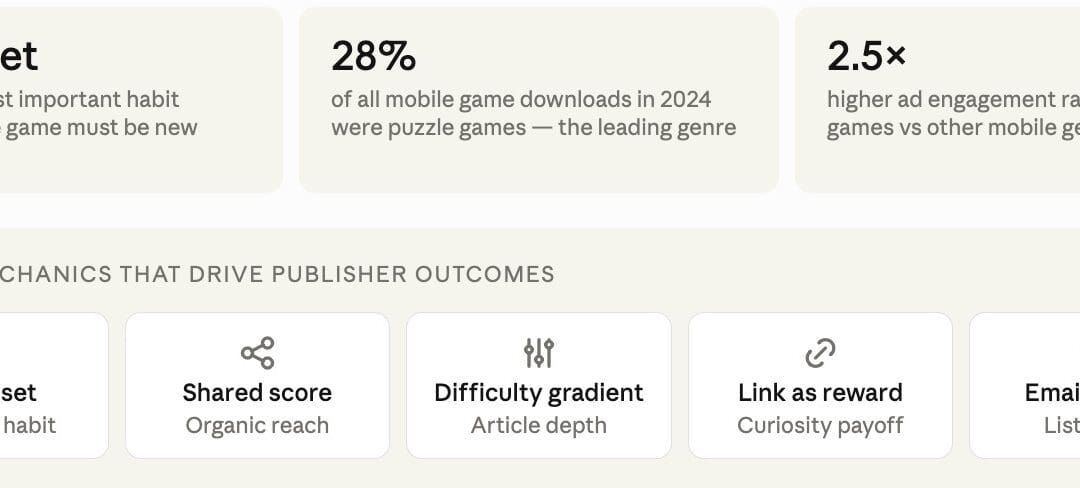
Not all games drive publisher outcomes. The ones that do share five specific design choices. The ones that fail tend to make the same three mistakes. This is what to look for when you are evaluating a games product.

Decision one: daily reset

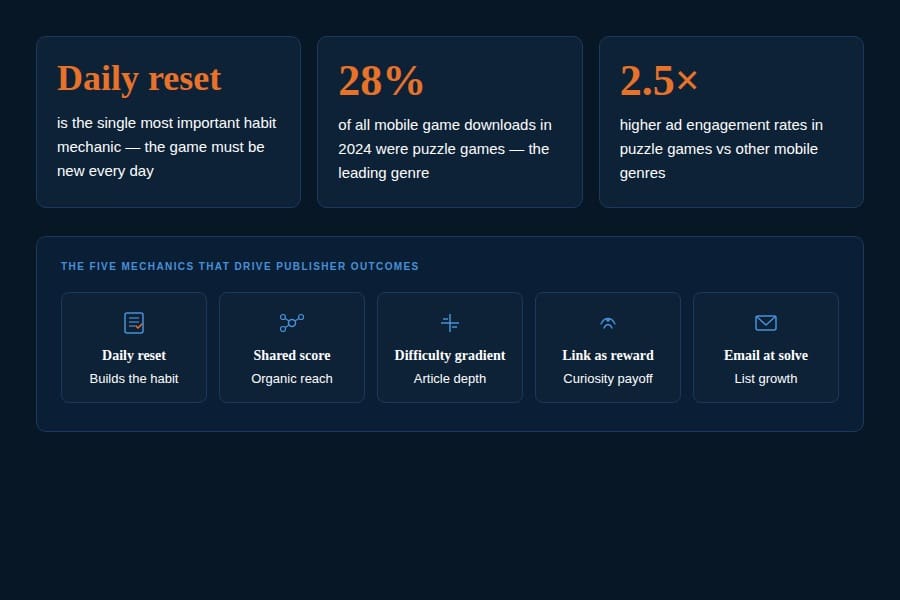
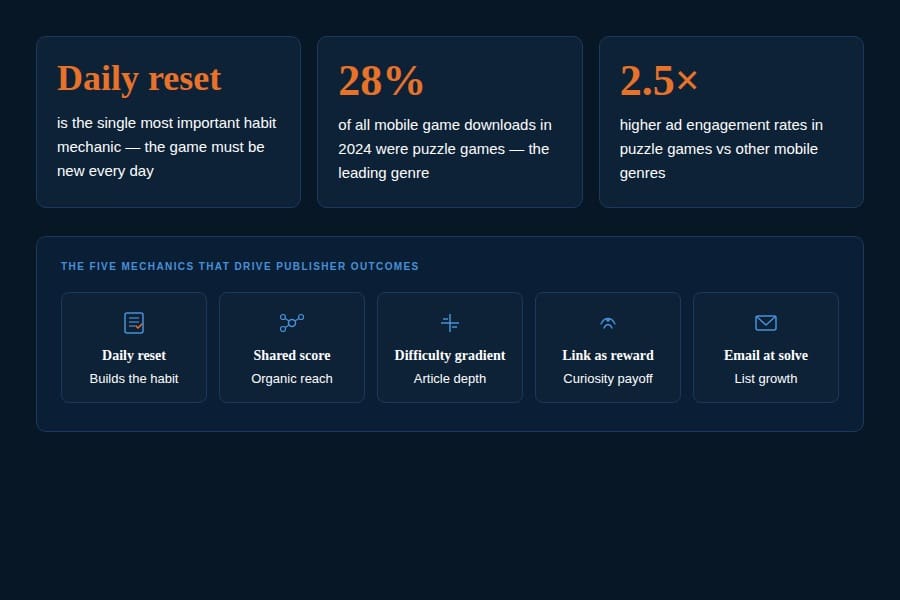
The single most important habit mechanic in any news-adjacent game is the daily reset. The game must be new every day. Not weekly. Not on-demand.

Not randomly generated when you choose to play.

Every morning, at the same time, a new puzzle appears, and yesterday's is gone.

This sounds simple. It is also the reason Wordle worked when similar word games had existed for years without achieving the same cultural traction. The daily reset creates a shared experience - everyone playing today's puzzle is playing the same puzzle - and it creates urgency. There is a reason to play today that will not exist tomorrow.

For a publisher, the daily

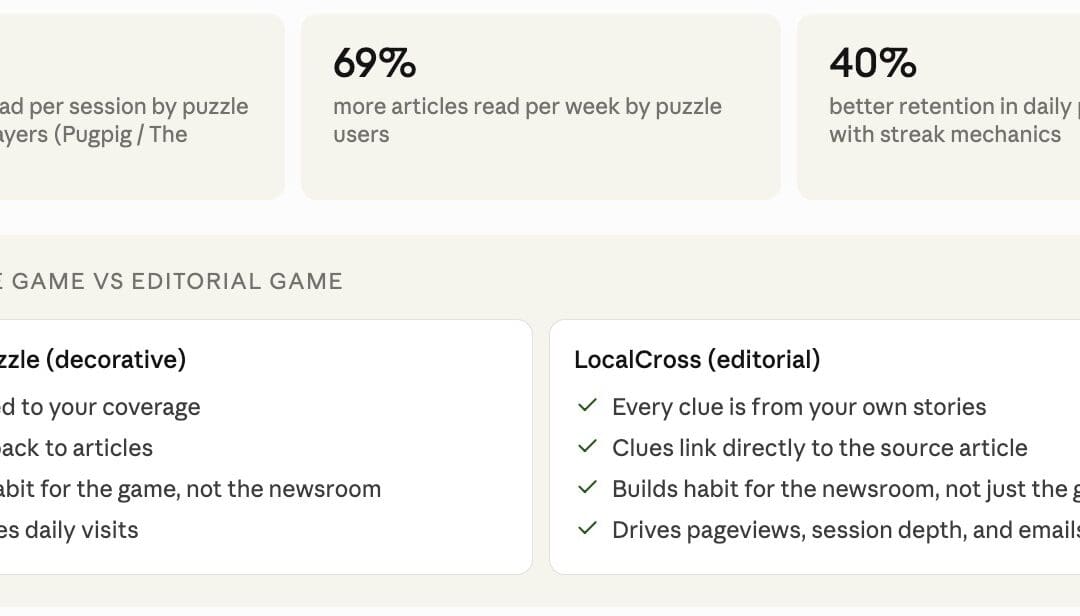
 reset is the mechanism that turns a game into a daily visit. Puzzle games with daily challenges show 40 percent better retention than those without. The reset is not a feature. It is the foundation.
Decision two: shared score

Wordle's shareable grid of colored squares was not incidental to its success. It was the distribution mechanism. Every player who shared their result on social media was, effectively, a free adve

rtisement for the game; one that came with a social proof signal (my friend plays this) and a challenge (can you do as well?).

For a local news game, the shared score has an additional dimension. Sharing your result on a crossword about your town is sharing something about your town. It is a community signal as well as a game signal. Local publishers who have integrated shareable results into their games report meaningful organic reach within their communities — reach that is qualitatively different from standard social media promotion because it comes from within the community, not from the publisher.

Decision three: difficulty gradient

A puzzle that is only difficult loses casual players before they develop the habit. A puzzle that is only easy loses the deeper engagement that drives article click-through. The right design uses a gradient — easy clues that get players started, medium clues that require reading, hard clues that reward close engagement with the coverage.

The three-level model maps directly to engagement depth. Easy clues (answered from the headline or first paragraph) expose the player to the story without requiring them to read it. Medium clues (requiring article body text) drive traffic. Hard clues (implied, requiring context) create the most memorable solves and the strongest motivation to understand the underlying story. Every difficulty level is a different kind of journalism engagement.

Decision four: the link as reward, not penalty

The article link cannot feel like homework. If the game interrupts play to say "you need to read this article to continue," most players will close the tab. The link has to feel like the payoff; the thing you want to click after a satisfying solve, because the clue made you curious about the story behind the answer.

This is a design and sequencing question, not just an editorial one. The link appears after the solve, when the game is done. It is presented as the source of the answer the player just found; not as a requirement, but as the explanation of something they now find genuinely interesting. The curiosity the clue created, the game satisfied. The article deepens it.

Decision five: the email ask

There is one moment to ask for an email address, and it is immediately after a successful solve. The player is at peak satisfaction. The game has just given them something. They are, briefly, in a state of mild gratitude and goodwill toward the publisher. This is the moment to ask.  Not before, not during, not in a separate prompt later.

The ask should not be a gate. Anyone who wants to skip it should be able to. But it should be present, visible, and paired with a clear newsletter opt-in that describes what the subscriber will receive. A well-designed email capture at this moment can achieve conversion rates that most publishers have never seen from any other acquisition mechanism.

The three mistakes that sink news games

The failures are as instructive as the successes. Three mistakes account for the majority of news games that fail to produce publisher outcomes.

First: unrelated content. A game that has no connection to the publisher's journalism (such as a generic puzzle syndication) passes the time but creates no editorial value. The player builds a habit around the game, not around the newsroom. When the publisher asks for a subscription, the game provides no reason to say yes.

Second: mandatory login before play. Requiring an account before the first game destroys the top of the funnel. Most potential players will not create an account for something they have never tried. The NYT's decision to keep Wordle free and ungated was the correct one. The email ask comes after the solve, when the player has already received value, not before.

Third: clues that are answerable without the article. If a player can guess the answer from general knowledge or context without reading the source story, the game has failed its primary editorial purpose. Every clue must be specific enough that it requires the article. That specificity is the editorial discipline that makes the game work.
Sources

Trust Is Still Journalism’s Superpower. A Daily Game Quietly Rebuilds It.

Trust Is Still Journalism’s Superpower. A Daily Game Quietly Rebuilds It.

If readers trust local journalism .. why are so few of them making it a daily habit?

Trust Is Still Journalism's Superpower. A Daily Game Quietly Rebuilds It.

Even as audiences drift to influencers and social video, research shows all generations still prize trusted brands with a track record for accuracy. The problem is not trust — it is the absence of a daily habit that keeps publishers present in readers' lives.

The trust paradox

Here is a fact that should be more encouraging than it seems: people still trust local journalism. They trust it more, in most surveys, than national media. They believe it is relevant to their lives. They think it is important that it exists.

And yet they are visiting less often. Engagement is falling. Subscriptions are stagnating. If readers trust local journalism and believe it matters, why are so few of them making it a daily habit?

The answer is that trust and habit are different things. Trust is an opinion people hold when they think about a news source. Habit is what they actually do every morning. A reader can trust their local paper completely and still spend their morning on TikTok, because TikTok has a better habit mechanism — infinite scroll, algorithmic personalisation, the social pull of seeing what their friends have seen.

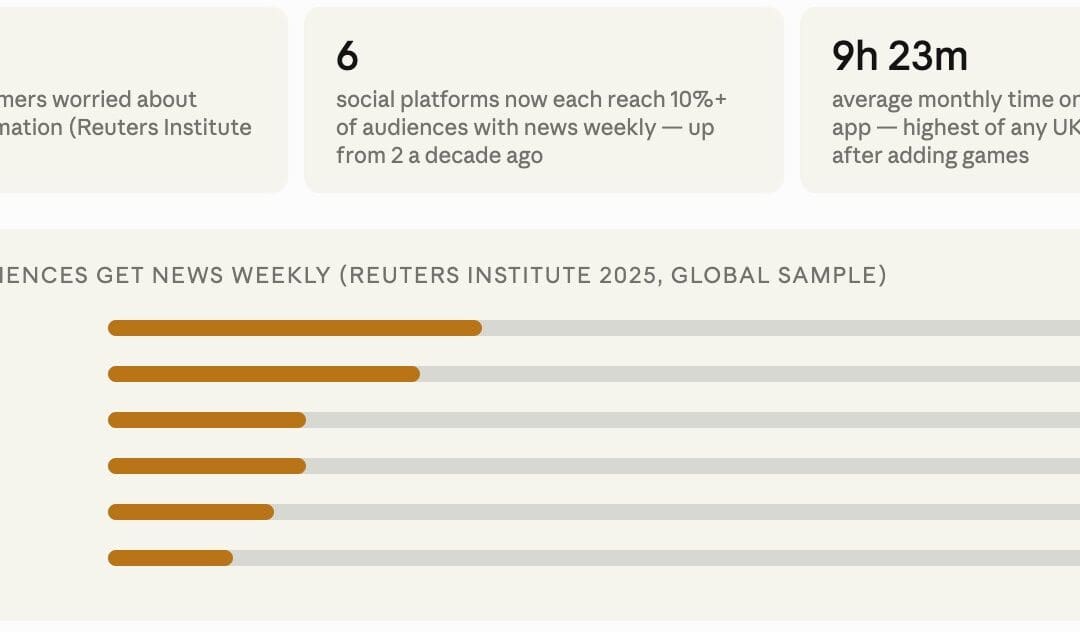
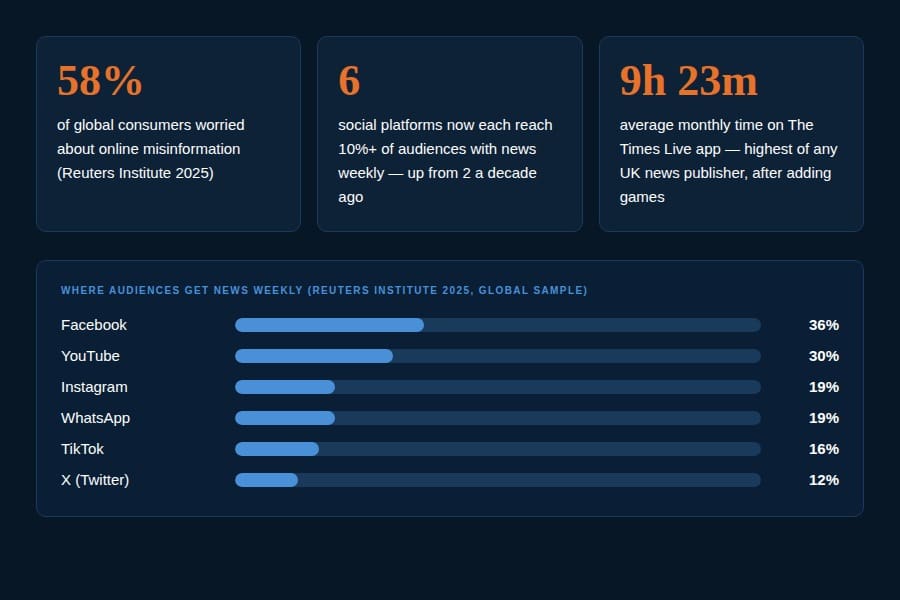
The Reuters Institute 2025 Digital News Report captures this clearly: even as audiences drift to influencers and video platforms, all generations still prize trusted brands with a track record for accuracy. The trust is there. The daily touchpoint is not.

What daily contact does that a great article cannot

A single excellent piece of local investigative journalism builds trust in a burst. It demonstrates what the newsroom is capable of. It may go viral within the community, attract new readers, and generate a wave of subscriptions. All of that is good.

But it is episodic. The effect fades. The readers who arrived for the investigation may not have a reason to return tomorrow. Trust built on exceptional moments is fragile in a way that trust built on daily contact is not.

A daily game builds trust quietly, visit by visit, without asking the reader to care about the news that day. The reader who plays your crossword every morning for three months has built a relationship with your domain that has nothing to do with any individual piece of journalism. When you ask them to subscribe, they are not being asked to trust a brand they know abstractly. They are being asked to support something already part of their daily routine.

The platform dependency problem

The six social platforms that each now reach more than 10 percent of global audiences with news every week— up from just two platforms a decade ago — are not neutral infrastructure. They are businesses with their own editorial priorities, their own monetisation models, and their own relationship with publishers, which has historically been extractive.

Every reader you reach through a social platform is a reader whose relationship with you is mediated by that platform. The platform controls the algorithm that decides whether they see your content. The platform controls the data generated by their engagement. The platform can change either of those things at any time, without notice, in ways that have nothing to do with the quality of your journalism.

A game hosted on your own domain, visited directly by readers who have built a habit around it, sits entirely outside this system. Publishers who are rebuilding their audience around owned channels — apps, newsletters, and direct traffic — are finding that these audiences are more loyal, more willing to pay, and more resistant to platform disruption than audiences built on social referral.

The neutral format, the wider audience

One of the underappreciated benefits of a daily game as an entry point is that it does not require the reader to have an opinion about your editorial stance. A reader who disagrees with your coverage of a local political issue will still play your crossword about their town. A reader who is fatigued by hard news will still engage with a puzzle. The game is politically neutral, anxiety-free, and genuinely fun — which gives it access to audiences that journalism alone cannot reach.

This matters in polarised local markets, where news avoidance is often correlated with political identity. The Reuters Institute 2025 report documents a deep divide in how conservatives and progressives relate to news media, with growing numbers on both sides tuning out. A game that is about the town — its streets, its businesses, its community events, its local government — rather than about political conflict is a format that can reach across that divide.

Trust as a subscription driver

The subscription conversion that follows daily game engagement is different in character from the conversion that follows a viral article. The game player who subscribes is not responding to a moment of peak interest in a particular story. They are formalising a relationship that already exists in practice.

They visit your site every morning. They know your voice. They have encountered your journalism through the puzzle clues. They are, in all meaningful senses, already a committed reader. The subscription is the acknowledgement of that. It is the easiest sales conversation you will ever have.

Sources

Why Your Crossword Clue Should Live Inside the Article — Not Outside It

Why Your Crossword Clue Should Live Inside the Article — Not Outside It

Designed to drive reader engagement - not dilute it

Why your crossword clue should live inside the article — not outside it

Most news games are decorative. They sit alongside the journalism but are not connected to it. The ones that move the needle are built on the opposite principle: the clue is only solvable if you read the story.

By Dave LaFontaine

The decorative game vs the functional game

A generic Sudoku on your homepage passes the time. It might even bring people back daily. But it does nothing for your journalism, your pageviews, or your first-party audience, because it has no connection to what you actually do. The game and the content are separate products that happen to share a URL.

A crossword where clue 5-Across is buried in today's city-council recap does something entirely different. It makes reading the article the path to solving the puzzle. The player is not being offered content as a reward for playing. The content is the game.

This distinction sounds simple. It has large consequences. Publishers who have added editorially integrated games report significantly higher article reads per session and per week compared to those running generic puzzle syndications. The engagement difference is not marginal. It is structural.


Three clue types, three depths of engagement

The clue-writing framework matters as much as the editorial integration. Not every clue should require deep reading — that would lose casual players before they develop the habit. The right approach uses three difficulty levels, each keyed to a different depth of engagement with the source article.

Headline clues are easy. The answer is in the headline or the first paragraph. A new reader can get these without opening the article at all — but they have still been exposed to the story, which is worth something.

Article-body clues are medium. The answer requires reading into the piece — finding a name, a number, a place that is specific enough not to be guessable. These clues are the primary traffic driver. The player who cannot immediately answer one has a choice: guess or read. Many read.

Implied clues are hard. The answer is not stated anywhere in the article — it requires connecting the story to a piece of context or background knowledge. These reward the engaged reader and create the most memorable solves. They also create the strongest motivation to click through to the article to understand the connection.

Each difficulty level is a different kind of journalism engagement. Together, they create a puzzle that works for readers at every level of engagement with your coverage — and pulls all of them deeper.


The curiosity debt mechanic

There is a psychological dynamic at work in a well-constructed article-linked clue that is worth naming: curiosity debt. When a clue creates a question the player cannot answer without reading the source material, the player is in a state of motivated uncertainty. They want to know. The article is the only place to find out. The clue has created a debt of curiosity that the article pays off.

This is a fundamentally different mechanism from a standard editorial call-to-action — a "read more" button, a related-story widget, a newsletter prompt. Those ask the reader to make an active choice to go further. A curiosity-debt clue makes not going further feel incomplete. The motivation is internal, not external.

The key design principle is that the clue must be specific enough that it cannot be guessed. A clue that asks for the name of the city councillor who voted against the rezoning can only be answered by someone who read the article. A clue that asks for "the name of a city councillor" is guessable and creates no debt.


Post-solve as the ideal moment

The placement of the article link matters as much as its existence. A link embedded mid-puzzle — before the player has finished — asks them to abandon the game to read the article. Most players will not do that. The link competes with the puzzle for attention, and the puzzle usually wins.

The right moment is after the solve. A player who has just completed a puzzle is in a specific mental state: satisfied, slightly elevated, and — if the clues have done their job — curious. They have been exposed to your coverage through the puzzle. They have unresolved questions about stories they only half-understand. The article links appear now, when the game is done and there is no competing pull.

This is why the Times Live app at The Times saw article reads rise 6 percent and topic readership jump from 2 to 17 percent after integrating games more deeply into its app. The games do not compete with the journalism. They prime the reader for it.


What to measure

The right metrics for a game-to-journalism integration are not game metrics — they are editorial metrics. Daily active players matters, but it is a vanity number unless it is paired with article click-through rate from the game, session depth on those linked articles, and email capture rate.

The question you are trying to answer is: does the game send readers into the journalism, and do they stay when they get there? Those two numbers — click-through rate from the game to the article, and time on page for those sessions — are the signal. Everything else is context.


Sources

The Three Legs of Local News Revenue Broke. Here is What is Left Standing

The Three Legs of Local News Revenue Broke. Here is What is Left Standing

The revenue crisis that has been going on for years 

The three legs of local news revenue broke. Here is what is left standing.

Print advertising. Digital display. Social referral traffic. All three collapsed inside a decade. This is not a content quality crisis — it is a distribution and revenue-model crisis. And the data points to one structural fix: owning the daily habit.

By Dave LaFontaine

Leg one: print advertising

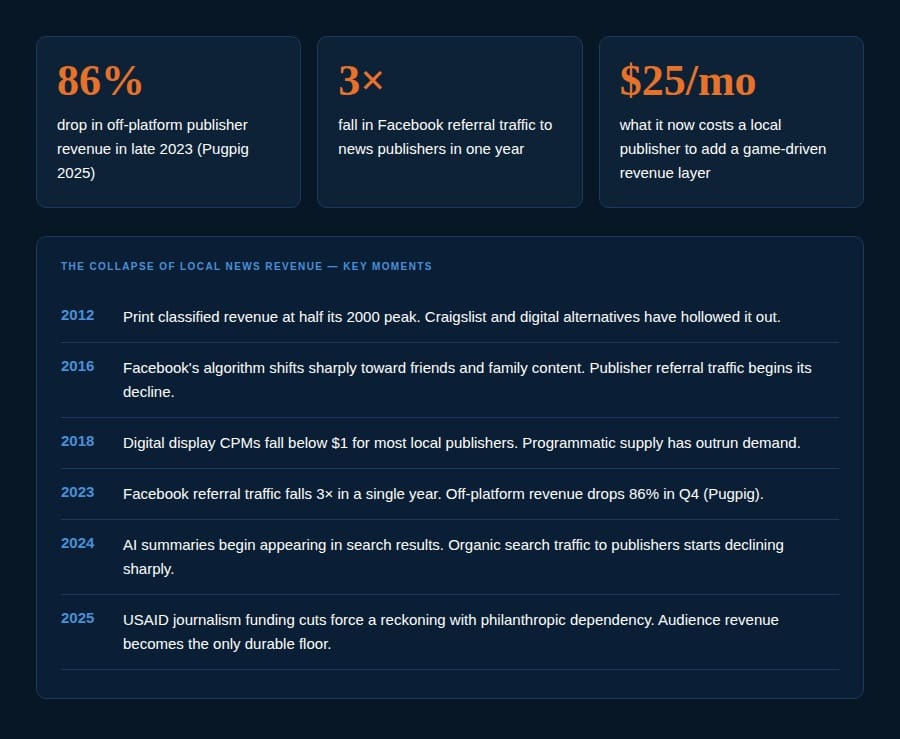
The collapse of print advertising is the one most publishers have already processed. It took the better part of two decades, which made it feel gradual — but by the early 2020s, print ad revenue for local publishers had fallen to a fraction of its 2000 peak.

What is less discussed is what went with it: the classified ads that funded community journalism for generations. Craigslist did not just kill a revenue line. It removed the financial relationship between local commerce and local journalism.

Most publishers adapted by moving online. But online turned out not to be the salvation it appeared.


Leg two: digital display advertising

Digital display advertising looked, for a moment, like the replacement. Page views were measurable. Advertisers could target by geography and interest. Local publishers could, in theory, compete for ad dollars that used to flow to print.

In practice, programmatic advertising collapsed CPMs — the price per thousand ad views — as the supply of ad inventory exploded across the web. Publishers with small, loyal local audiences found themselves competing in a market that rewarded scale above all else. Google and Facebook captured the majority of digital ad spend. Local publishers got the remainder, at rates that made the economics increasingly difficult to justify.

The digital display bet did not pay off. It created dependency on platforms that were indifferent to local journalism's survival.

the three legs of revenue

Leg three: social referral traffic

The third leg broke fastest.

Social media — particularly Facebook — had become the primary distribution channel for many local publishers. It was free, it reached large audiences, and it drove traffic that could be monetised through display ads. Publishers built editorial and distribution strategies around it.

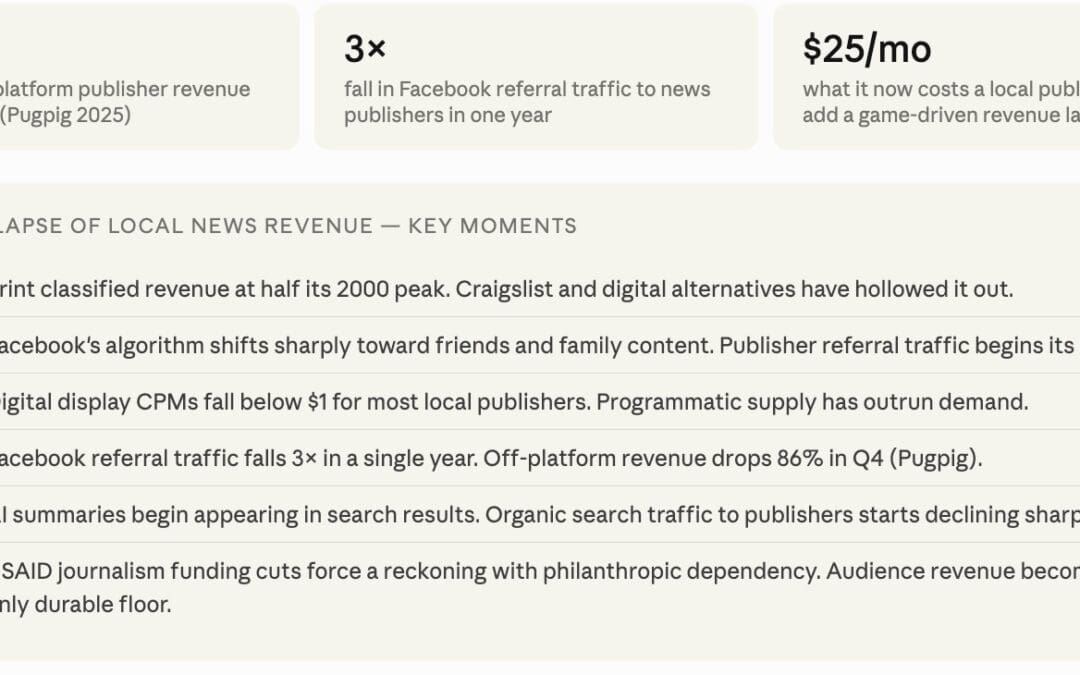
Then Facebook changed its algorithm. And changed it again. And again.  Each change reduced the organic reach of publisher content. Then, in a single year, referral traffic from Facebook to news publishers fell by a factor of three. Off-platform publisher revenue dropped 86 percent in the final quarter of 2023.

And then came AI. Search, which had held up reasonably well through the social collapse, began to erode as AI summaries started appearing at the top of results pages, answering questions without the user needing to click through to the source. Organic search traffic — the last reliable free distribution channel — began its own decline.

The platforms were never partners. They were distribution channels that publishers did not control, and they behaved accordingly.

What is still working

The publishers who are navigating this most successfully have one thing in common: they are investing in owned channels, such as apps, newsletters, and direct traffic - rather than platform-dependent distribution. Audiences who come to you by habit rather than by algorithm are the only durable base. You cannot be algorithm'd out of a relationship your reader has built directly with your site.

This is where a daily game becomes a structural argument, not a gimmick. A reader who visits your site every morning to play a crossword built from your own stories is a direct-traffic user. Their visit is not mediated by any platform. Their email address is yours. Their habit is built around your journalism.

The GFMD roundup from the International Journalism Festival 2025 in Perugia was direct on this point: collaboration accelerates innovation, but the foundation of sustainability is audience engagement — meeting readers where they are and giving them a reason to stay.


First-party data as the new oil

The collapse of third-party cookies (combined with Apple's App Tracking Transparency changes) made first-party data the most valuable asset in digital publishing. An email address collected from a willing subscriber is worth more, in terms of long-term monetizable value, than hundreds of pageviews from an anonymous social referral.

A daily game that captures an email at the moment of a successful solve, with a visible newsletter opt-in, not a mandatory gate ... that is a first-party data machine. Every player who finishes your crossword and signs up for your newsletter is a relationship you own outright. No platform can take it away.

The math is worth doing. Flat plans from $25 a month cover the game's hosting and puzzle generation. One local sponsor on the game can cover that subscription many times over.

A share of  LocalCross' ad revenue comes back to the publisher monthly. The email list the game builds is a compounding asset.

None of these revenue lines depend on a grant cycle or an algorithm.


Sources