
Why Philanthropy Cannot Save Local News Alone — and What Sustainability Actually Looks Like
FUNDING CRISIS
Why Philanthropy Cannot Save Local News Alone — and What Sustainability Actually Looks Like
After USAID cuts and shifting donor priorities, journalism funders at IJF 2025 were direct: project grants are not a business model. Audience revenue is the only durable floor. Here is what that means in practice.
The scene at Perugia
Every April, the International Journalism Festival in Perugia brings together the people who make, fund, and study journalism from around the world. In 2025, funding and sustainability dominated the conversation in a way that felt different from previous years — less diagnostic, more urgent. The USAID funding cuts had forced a reckoning that everyone in the room already knew was coming but had been able to defer. Now it was here.
The message that emerged from the funding-focused sessions was blunt: journalism that depends on any single funder, be it government, philanthropic, or corporate - is one decision away from a crisis. The dependency itself is the vulnerability, regardless of how well-intentioned the funder is or how important the journalism.
What the USAID shock revealed
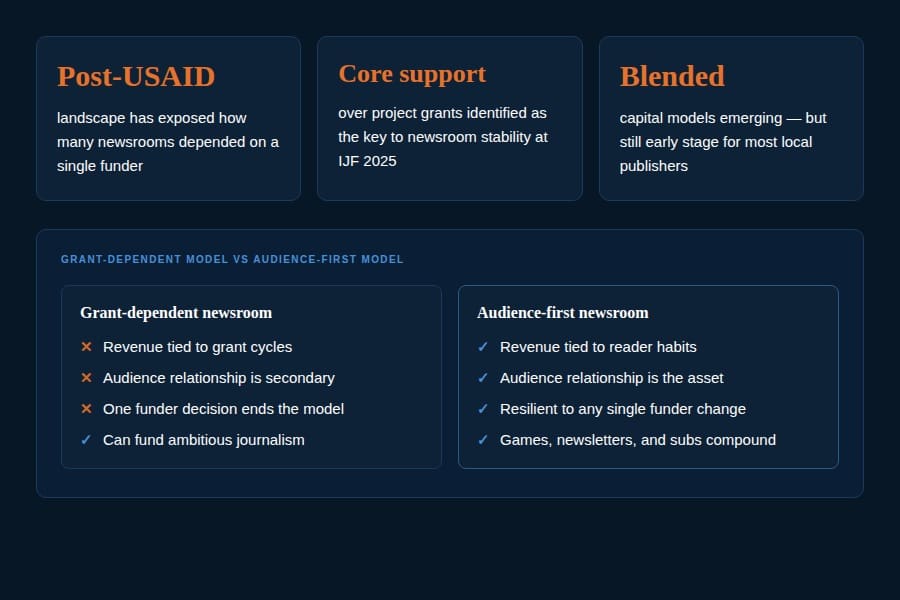
The reduction of USAID funding exposed how many independent newsrooms had built their operating models around a single large source of grant funding. When that source dried up, the downstream effects were immediate and severe.
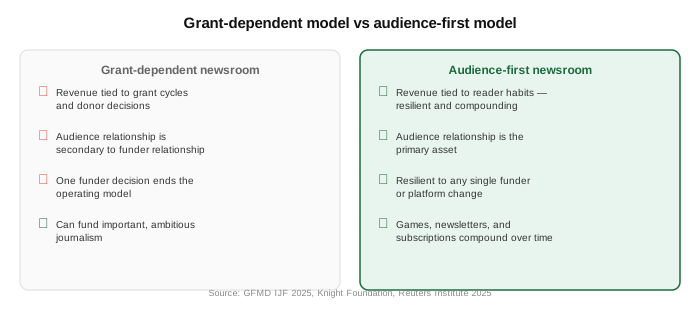
This is not a criticism of those newsrooms. Grant funding has long enabled important journalism that would otherwise not have existed. But the IJF 2025 sessions were explicit: long-term core support beats project-based grants as a sustainability model, and core support from any single source is itself a fragile foundation. The only genuinely resilient model is one where audience revenue forms the floor — the base that cannot be removed by a single external decision.
What journalism funders recommend
The sessions at Perugia identified several directions worth tracking. Impact investing — blended capital that combines financial returns with positive social outcomes — was discussed as a potential new frontier for journalism funding. Collaboration between newsrooms was identified as a mechanism to share costs and accelerate innovation. Taxing large technology companies to fund journalism was on the agenda, with several European jurisdictions already pursuing versions of this model.
But the thread running through all of these was the same: none of them work without an engaged audience at the foundation. Impact investors need evidence of audience relationships to assess the social return on their investment. Collaboration works best between newsrooms that are each independently viable. Tech taxes produce a pool of money, but the newsrooms best positioned to access it are the ones that can demonstrate audience value.
Audience engagement is not one pillar of sustainability among several. It is the precondition for all of the others.
If nobody is engaged with the news you are producing … what is the point?
Impact investing: promising but early-stage
The impact investing model is genuinely interesting for local journalism, but it is not a 2025 solution for most community publishers. The infrastructure — the investors, the intermediaries, the measurement frameworks — is still being built. The newsrooms best positioned to access this capital in the next few years are those that can demonstrate clear financial strategies, diversified revenue streams, and evidence of audience engagement.
In other words: building a sustainable audience-first model now is the best preparation for accessing impact investment later. The two strategies are not alternatives. They are sequential.
The audience revenue case
A subscriber who arrives through a daily game is different from one who arrives via a grant-funded audience acquisition campaign. Meanwhile, a game player has built a habit before they were asked to pay. Their subscription is the formalization of a relationship, not a response to a promotional moment. Churn rates for this kind of subscriber tend to be lower, because the habit the game created persists after the subscription begins.
The compounding nature of this matters. An email list built through a daily game grows with each new player. The newsletter open rates among game-sourced subscribers tend to be higher than those from other acquisition channels, because the daily game habit has already primed the reader to expect daily contact from the publisher.
And none of it depends on a grant cycle, a donor decision, or a platform algorithm. The Knight Foundation's Catalyst program has identified audience-first revenue models as a priority for local news sustainability precisely because they build the kind of durable foundation that grant funding cannot. The game is not a distraction from the sustainability mission. It is the sustainability mission.
Sources
The NYT Didn’t Intentionally Set Out To Become a Games Company. Local Publishers Should.
How Wordle Supercharged the New York Times – and What Local Publishers Can Learn From It
The NYT spent low seven figures on a free word game and added nearly 3 million digital subscribers in two years.
Here is the actual mechanism, and why it translates directly to community newsrooms.
First: The Bet That Nobody Believed
In January 2022, the New York Times paid somewhere in the low seven figures for a game to add to their growing "Puzzles" section.
Not a news product. Not a podcast. Not an investigative unit. A word game that reset every day and took about three minutes to play. The people who ran it had no staff. The game had no ads. It charged nothing. The Times bought it anyway.
At the time, plenty of smart people thought it was a strange use of money. The Times had a journalism operation to fund. It had reporters, editors, printing presses, a paywall to defend. Why spend millions on something you were going to keep giving away?
Sure, newspapers had long had crossword puzzles and other games in their print editions - people actually make it a point of pride when they "can do the Times crossword puzzle using an ink pen, not a pencil!"
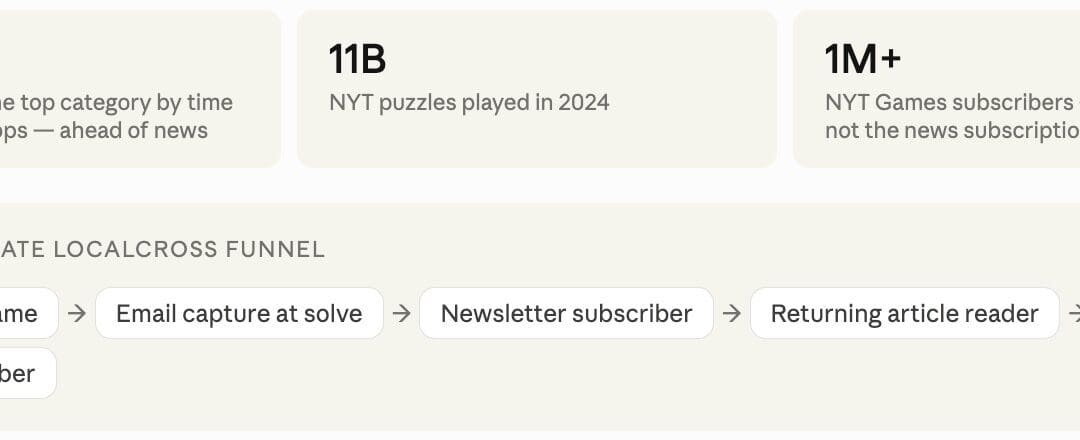
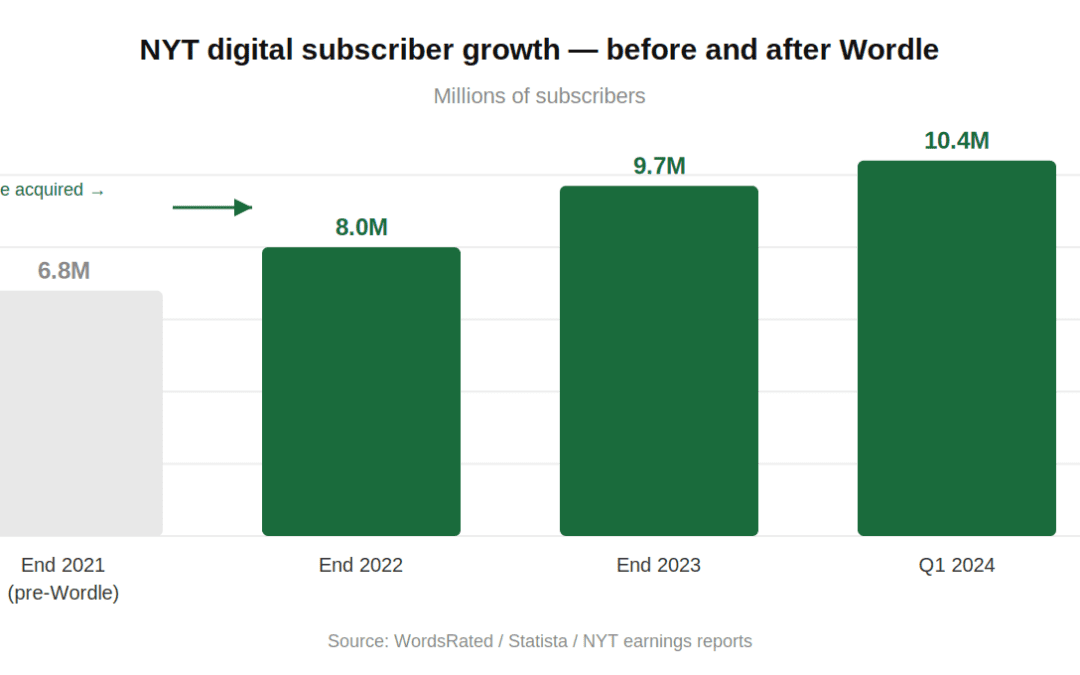
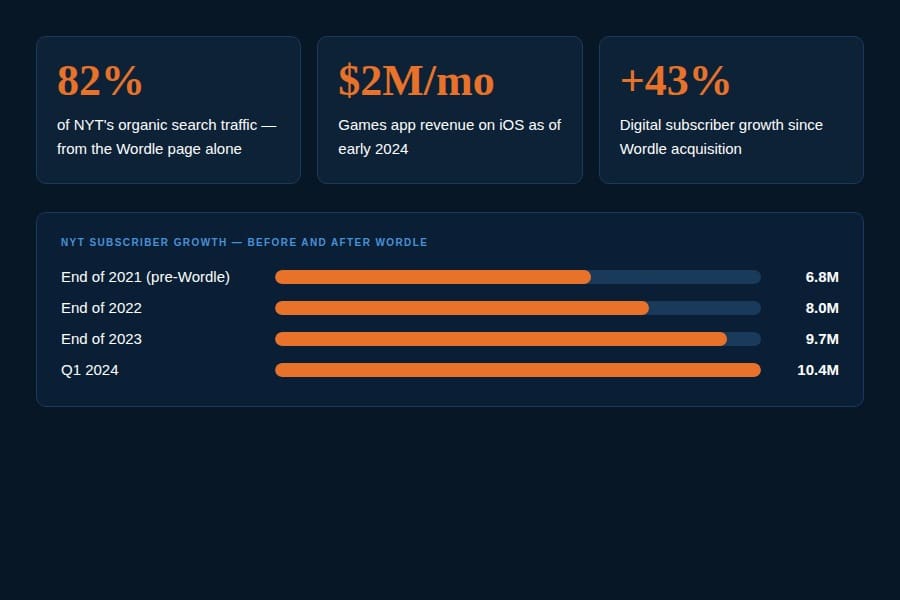
Two years after they bought it, the Wordle page alone accounted for 82 percent of the Times's total organic search traffic. The games app was pulling in two million dollars a month on iOS. Digital subscribers had grown by nearly three million — a 43 percent jump since the acquisition. Games were, by time spent, the single biggest product the Times had. Bigger than the news. The bet had worked. And almost nobody had seen it coming — including, by most accounts, the Times itself. That is the part worth paying attention to if you run a local newsroom.
Why free was the whole strategy
When Wordle moved to the Times, the critical decision was to keep it free. No paywall. No login required. No subscription prompt before the first play. The game was a front door, not a revenue line — at least not directly.
This confused people.
The Times was spending real money on user acquisition through a product that charged nothing. But the logic was straightforward once you saw it: Wordle brought tens of millions of new users to the Times domain who had never been there before. Many of them stayed to explore. A meaningful share signed up for games subscriptions.
A further share converted to full news subscribers. The game was the top of a funnel that had never existed before. Free was not generosity. Free was the business model. For a local newsroom, the parallel is direct. A daily crossword built from your own stories and hosted on your own domain (one that is free to play, no subscription required) gives people a reason to visit your site who would never have opened a headline.
Once they are there, you have a relationship to build.
The habit loop, and why it works
Wordle is not complicated. You get six tries to guess a five-letter word. The game resets every day. Everyone in the world plays the same puzzle on the same day.
 When you finish, you get a shareable grid of coloured squares.
Those four design choices:
- daily reset
- universal puzzle
- limited attempts
- shareable result
... are not accidents. They are the mechanics of habit formation. The daily reset gives you a reason to come back tomorrow.
The universal puzzle gives you something to talk about with other people. The limited attempts create stakes. The shareable result turns every player into a distribution channel. Research on puzzle game engagement confirms the pattern. Puzzle games with daily challenges show 40 percent better retention than those without.
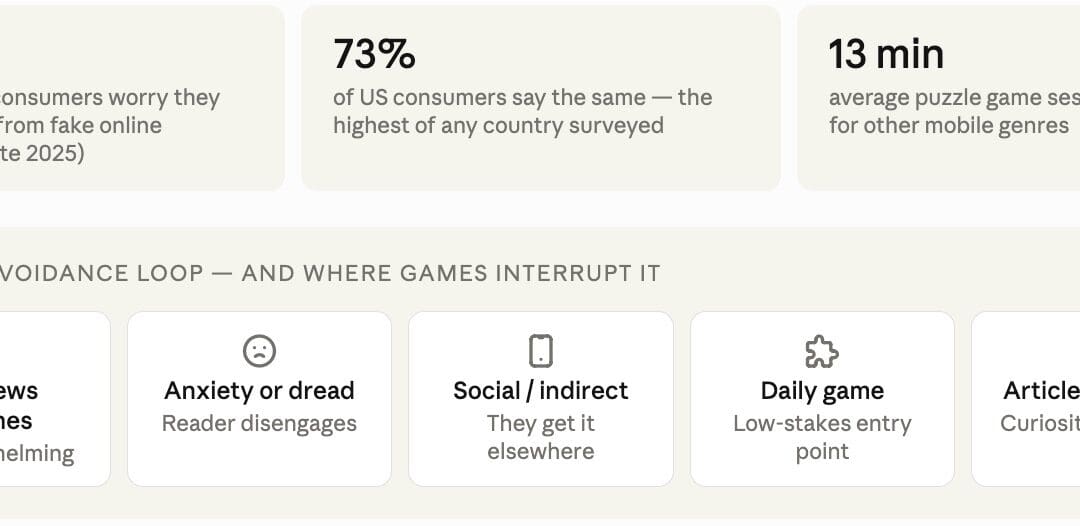
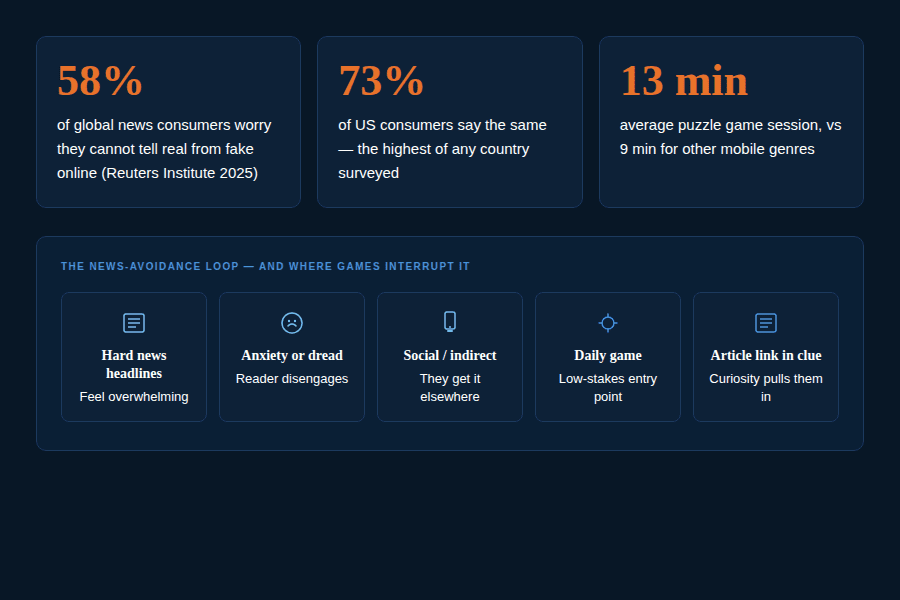
Players average 13 minutes per session — significantly above the nine-minute average for other mobile gaming genres. The engagement is deep, and it comes back Every. Single. Day.
We built LocalCross so that it builds on your own content, and thus rewards readers who pay attention to the news you produce. The daily/weekly/monthly reset becomes part of their routine. The shared score becomes a conversation about your town.
The habit builds around your journalism.
The numbers that should matter to a local publisher
The Times's scale is obviously different from a community newsroom. But the underlying mechanics are not. Consider what actually happened at the Times at a structural level, stripped of the zeros:
- A free product created a daily reason to visit the domain.
- That visit generated a first-party relationship — an email address, a browser session, a known returning user.
- A share of those users converted to paid subscribers over time.
- The subscriber who arrived through a game proved stickier than one who arrived through a social referral, because the game built a habit before it asked for anything.
None of that depends on Times-scale resources. The Pugpig 2025 Media App Report studied publisher app engagement across newsrooms of very different sizes and found the same pattern consistently: publishers with games saw higher session frequency, longer time per visit, and more article reads per user than those without.
"... article-first apps have a wider range of digital mobile content, and audiences who use them often have shorter sessions, indicative of mobile snacking rather than edition browsing. Publishers are shifting to this mobile-first approach because the wider range of content from editions to puzzles, audio and video still delivers engagement but also attracts new audiences."
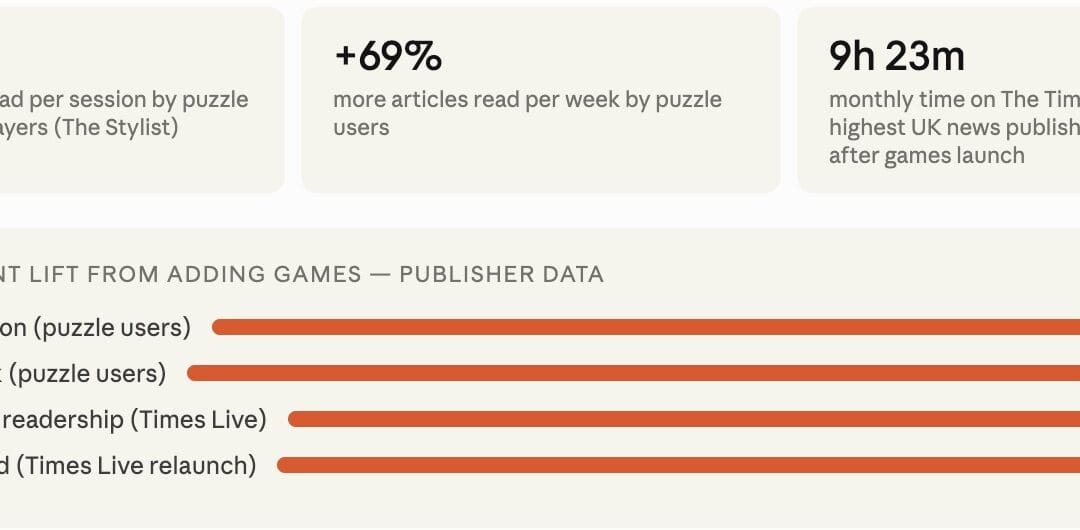
The Stylist — not the Times — showed the sharpest single data point: puzzle users read 31 percent more articles per session and 69 percent more per week than non-players. That is a mechanism, not a coincidence. A completed puzzle puts a reader in a state of satisfied curiosity. That is the ideal moment to surface an article.
What to take from this
The Times did not set out to become a games company. The strategy revealed itself through a series of individual bets, each of which happened to work. A community publisher does not have the runway for that kind of discovery process. But the lesson is clear enough to act on deliberately.
A daily game built from your own stories and embedded on your own site is not a distraction from journalism — it is a distribution mechanism for it. It gives readers a daily reason to visit. It builds the habit before you ask for a subscription. It captures the email address that social media never will.
The Times stumbled into this. You do not have to.
Sources
The “News Avoider” is Not Who You Think — and a Daily Game Might Be the Bridge Back
The news avoider is not who you think — and a daily game might be the bridge back
Millions of people have stopped opening news apps. But research shows they haven't stopped caring about their communities — they're just consuming news indirectly, and a low-stakes daily game is a different kind of entry point.
Who news avoiders actually are
The phrase "news avoider" conjures a particular image: someone checked out, disengaged, wilfully uninformed. The data tells a more complicated story.
Research published by the Columbia Journalism Review found that so-called news avoiders are not really skipping out on the news at all. They have alternative, often indirect sources of information — friends, social conversations, podcasters, ambient awareness.
The attitude is less "I don't care" and more "I'll hear about it eventually." They are still connected to their communities. They are just not coming to publishers for that connection. The reasons vary. For some it is anxiety — the relentless cadence of hard news creates a feeling of dread that makes opening an app feel like a punishment.
For others it is time. For others still, it is a creeping sense that the news they receive is not really about them or their community. The Reuters Institute 2025 Digital News Report found that growing numbers of people are selectively — and in some cases consistently — avoiding the news.
This is not a niche behavior. It is accelerating across age groups and markets.
 Photo by Tony Tran on Unsplash
Why hard news pushes people away
There is a design problem at the heart of how most news is delivered. Headlines are optimised for urgency and consequence. The implicit message of most news apps is: something bad is happening, you should know about it, here is more bad news below.
For readers who are already stressed, that experience is actively unpleasant. The news-avoidance response is rational. If consuming news makes you feel worse, you consume less of it. This is not a failure of journalism — it is a failure of the delivery mechanism. The journalism may be important, accurate, and locally relevant.
The experience of receiving it is still aversive. What is needed is a format that creates a different first feeling. Something that does not lead with consequence and urgency. Something that gives the reader a sense of agency and completion rather than dread and overwhelm.
The neutral format advantage
A puzzle makes no political demands. It does not ask you to feel anything about a headline. It presents a small, solvable challenge with a tidy answer at the end. The emotional experience is almost the exact inverse of a hard news digest.
This matters because it widens the aperture of who you can reach. A reader who would never click a headline about the city council vote will still play a daily crossword about their town — especially if the clues are genuinely local. The puzzle is the packaging. The journalism is the substance inside it. The indirect news consumer — the person who says "I'll hear about it eventually" — is not hostile to local coverage.
They are just looking for a different kind of on-ramp. A daily game that is built from your own stories and resets every morning is exactly that on-ramp. It meets people where they are, in a format they already use, without leading with anxiety.
The game-to-story bridge
The critical design question is what happens after the solve. A game that entertains and disappears does nothing for a publisher. A game where the clues are built from real articles, and where those articles are linked from inside the game, does something structurally different. When a player encounters a clue about the new bridge on Main Street, or the school board meeting, or the flooding on Elm Street, and cannot immediately answer it, the natural response is curiosity.
That curiosity is a kind of debt — the player owes the article a visit to get the answer. The game creates the interest; the journalism pays it off.
And critically, the link appears after the solve — at the moment of maximum satisfaction, when the player is not anxious or overwhelmed, but pleased with themselves and curious about the world. That is a fundamentally different mental state from clicking a headline in a news feed, and it produces meaningfully different engagement.
Research from the Pugpig 2025 Media App Report bears this out. Publishers who added games found that puzzle users read significantly more articles per session and per week than non-players. The game does not distract from the journalism. It primes the reader for it.
A crossword clue is still journalism
There is sometimes an anxiety among publishers that games are somehow beneath their mission. That editorial credibility requires staying in the lane of hard news delivery, and that anything lighter is a compromise.
A better way to think about it: a clue that tells a reader to find the name of the engineer behind the new flood barrier in this morning's infrastructure story is journalism. It is a different format, but it is doing the same work — making local news discoverable and relevant to people who live in the community it covers.
The news avoider is not lost. They are just waiting for a reason to come back that does not feel like homework. A daily game built from your own stories is that reason.